

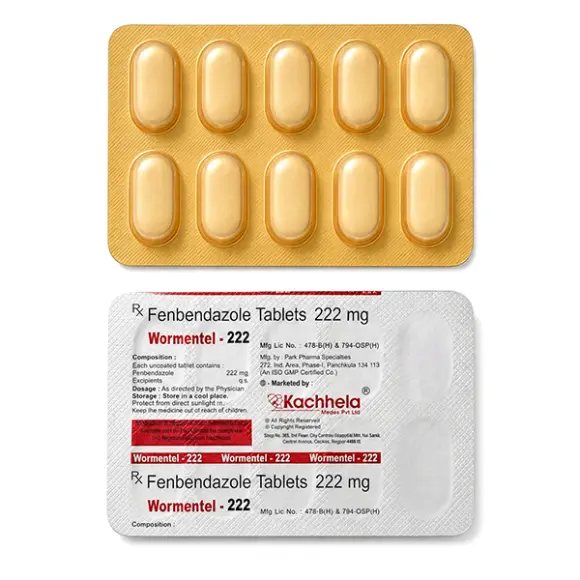
Wormentel 222 mg Tablet (Fenbendazole)
Wormentel 222 mg is an antiparasitic tablet containing Fenbendazole, a medicine used in veterinary care to treat certain intestinal worm infections in animals. It belongs to the benzimidazole group of medicines and works by interfering with the way susceptible parasites absorb nutrients and produce energy.
Pack options
Choose Your Pack
Review prescription requirements before ordering. Ask a qualified healthcare professional about suitability.
| Brand | Wormentel 222 mg |
| Active ingredient | Fenbendazole 222 mg |
| Drug class | Benzimidazole Anthelmintic |
| Used for | Parasite infections |
| Dosage form | Film-coated oral tablet |
| Strength | 222 mg |
| Manufacturer | Kachhela Medex Pvt. Ltd. |
| Pack | Strip of 10 tablets |
| Prescription | Required |
| Storage | Below 30°C, dry place, away from light |
What is Wormentel 222 mg?
Wormentel 222 mg is a fenbendazole-based antiparasitic product. Each tablet contains 222 mg of Fenbendazole, an ingredient used in veterinary medicine to manage infections caused by certain parasitic worms.
Fenbendazole has been used in animal healthcare for many years. It belongs to a family of medicines called benzimidazoles, which interfere with important processes inside susceptible worms. This helps control infections that may affect an animal’s digestive health and general condition.
Wormentel is supplied in tablet form and is manufactured by Kachhela Medex Pvt. Ltd. The 222 mg strength describes the quantity of Fenbendazole in each tablet. It does not mean that one tablet is a suitable dose for every animal.
Although Fenbendazole is related to some medicines used in humans, such as Albendazole and Mebendazole, it is not an FDA-approved human medication. People with suspected intestinal worm infections should seek medical advice and use treatments approved for their condition.
What is Wormentel 222 mg used for?
Wormentel 222 mg contains a broad-spectrum antiparasitic ingredient. In veterinary medicine, Fenbendazole is used against several types of intestinal worms, although the specific treatment depends on the animal species, parasite and product formulation.
Roundworm infections
Roundworms are intestinal parasites that may affect dogs, cats, livestock and other animals. Some infected animals develop vomiting, diarrhea, abdominal swelling or poor weight gain. Others may show no obvious symptoms.
Fenbendazole can treat certain roundworm species when administered according to an appropriate veterinary treatment plan.
Hookworm infections
Hookworms are small parasites that attach to the intestinal lining and feed on blood. Significant infections can cause anemia, weakness, digestive problems and poor growth, particularly in younger animals.
Fenbendazole is effective against certain hookworms, but the veterinarian must identify the likely parasite and select the correct treatment.
Whipworm infections
Whipworms commonly affect the large intestine of susceptible animals. They can cause recurring diarrhea, weight loss and irritation of the digestive tract.
Fenbendazole is used for certain whipworm infections in veterinary care. Follow-up testing or additional treatment may be needed because reinfection can occur.
Certain tapeworm infections
Some Fenbendazole formulations are effective against particular tapeworm species. However, it does not reliably treat every type of tapeworm.
A veterinarian may recommend another antiparasitic medicine depending on the species involved.
Important: These uses describe established veterinary applications of Fenbendazole. They should not be interpreted as approved human indications for Wormentel 222 mg.
How does Wormentel 222 mg work?
Fenbendazole acts on structures inside susceptible parasitic worms called microtubules.
Microtubules help cells maintain their shape, transport materials and carry out essential functions. They are formed from a protein called tubulin.
Fenbendazole binds to parasite beta-tubulin and interferes with the formation of these structures. As a result, susceptible worms become less able to absorb glucose and maintain their energy supplies.
Without enough energy, the parasites gradually lose their ability to survive. This process helps the animal’s body eliminate the infection.
The medicine is not equally effective against every parasite. Its activity depends on the worm species, treatment schedule and sensitivity to Fenbendazole.
The treatment also does not provide permanent protection against future infections. Animals can become infected again through contaminated soil, food, water or contact with infected environments.
How to use Wormentel 222 mg?
Wormentel 222 mg should only be administered to an animal when a veterinarian has confirmed that the product and its formulation are appropriate.
The correct amount of Fenbendazole depends on several factors, including body weight, animal species, parasite type and the condition being treated.
A veterinarian may recommend a course lasting several days. Some infections require repeat treatment or follow-up testing to confirm that the parasites have been cleared.
Before administering the tablet, check the product label and verify that the formulation is suitable for the animal.
Do not assume that a 222 mg tablet can be divided or administered in the same way as another Fenbendazole product. Different formulations may have different instructions, and not every tablet is designed to be split or crushed.
Food instructions also vary between formulations and species. Follow the veterinarian’s advice rather than applying a general dosing rule.
Wormentel 222 mg should not be self-administered by humans. There is no established, FDA-approved human dosage for Fenbendazole.
What are the side effects of Wormentel 222 mg?
Fenbendazole is generally tolerated by many animals when used according to approved veterinary instructions. However, unwanted effects can occur, and the risks may increase when it is given at inappropriate doses or for longer than recommended.
Common side effects in animals
Possible reactions include:
- Vomiting or an upset stomach
- Diarrhea or changes in stool
- Temporary loss of appetite
- Increased drooling in some animals
- Allergic reactions in susceptible animals
Some digestive symptoms may also be related to the parasite infection itself rather than the medicine.
Serious side effects
Rare but serious problems have been reported with Fenbendazole use, particularly with prolonged treatment outside approved instructions.
The FDA has reported cases of bone marrow suppression and pancytopenia in dogs receiving prolonged extra-label Fenbendazole treatment. Pancytopenia means that several types of blood cells become unusually low, which may increase the risk of infection, bleeding and weakness.
Seek veterinary help if an animal develops unusual bruising, severe weakness, pale gums, persistent vomiting or other concerning symptoms.
Possible risks in humans
There is not enough reliable clinical evidence to establish the safety of Fenbendazole in humans.
Published medical reports have linked self-administered Fenbendazole with serious liver injury. Symptoms requiring prompt medical attention can include yellowing of the skin or eyes, dark urine, severe fatigue and persistent abdominal pain.
Wormentel 222 mg precautions and warnings
Before using any Fenbendazole-containing product, it is important to understand the precautions associated with the medicine.
Animal species: A medicine suitable for one species may not be appropriate for another. Confirm that the specific Wormentel formulation is suitable for the animal being treated.
Pregnancy and nursing: Fenbendazole has been studied in certain pregnant animals, but safety instructions vary by species and formulation. Veterinary advice is necessary before treatment.
Young or sick animals: Puppies, kittens and other young animals may need special consideration. Animals with existing illnesses should be examined before treatment.
Liver health: Animals with liver disease or unexplained health problems require veterinary assessment before receiving medication.
Food-producing animals: Treatment of livestock must follow applicable veterinary regulations and any required meat or milk withdrawal periods.
Human exposure: Fenbendazole is not an approved human medicine in the United States. It should not be used to self-treat worms, cancer or other medical conditions.
Wormentel 222 mg drug interactions
The possibility of drug interactions should be considered whenever an animal is receiving more than one treatment.
A veterinarian should know about any existing prescription medicines, deworming products, supplements or other treatments the animal receives.
Using multiple antiparasitic medicines without professional guidance may expose the animal to unnecessary treatment or unexpected adverse effects.
Some combination therapies are appropriate under veterinary supervision, but this does not mean every combination is safe.
Human drug interaction data for Fenbendazole are limited. The absence of a reported interaction does not establish that combining it with other medicines is safe.
What happens if a dose is missed or too much is given?
Missed dose
If an animal misses a scheduled Fenbendazole dose, contact the veterinarian or follow the specific product instructions.
Do not automatically give two doses together to compensate for a missed treatment. The correct response depends on the parasite being treated and the recommended course.
Overdose
If an animal accidentally receives too much Wormentel 222 mg, contact a veterinarian immediately.
Provide the animal’s weight, the product strength, the quantity administered and the approximate time of exposure.
If a person accidentally swallows the product, contact a poison control service or medical professional for advice. Do not attempt to treat the exposure using another medication without guidance.
Wormentel 222 mg and cancer: What does the research say?
Fenbendazole has attracted attention because some laboratory studies have explored whether it may affect processes involved in cancer cell growth.
However, results from laboratory experiments cannot establish that a substance will work safely or effectively as a cancer treatment in people.
There is currently no robust clinical evidence showing that Fenbendazole is a safe or effective treatment for human cancer. It is not FDA-approved for cancer treatment, and self-medication may delay proven therapies or cause serious side effects.
People receiving cancer treatment should discuss any supplements or additional medicines with their oncology team.
Wormentel 222 mg vs other antiparasitic medicines
Fenbendazole belongs to the same broad drug family as Albendazole and Mebendazole, but these medicines are not interchangeable.
| Medicine | Active ingredient | Main medical application |
|---|---|---|
| Wormentel 222 mg | Fenbendazole | Veterinary parasite control |
| Albendazole products | Albendazole | Selected human parasitic infections |
| Mebendazole products | Mebendazole | Selected human intestinal worm infections |
| Panacur veterinary products | Fenbendazole | Animal deworming, depending on product approval |
Albendazole and Mebendazole have approved human applications in various countries. The appropriate medicine depends on the diagnosis, patient characteristics and local treatment guidelines.
A person should not substitute veterinary Fenbendazole for an approved human deworming medicine.
How to store Wormentel 222 mg
Correct storage helps protect the product from moisture, damage and accidental exposure.
- Keep tablets in their original packaging.
- Store according to the temperature and humidity instructions on the label.
- Protect the medicine from excessive heat and direct sunlight.
- Keep the product away from children and animals that could accidentally swallow it.
- Check the expiry date before administration.
- Do not use tablets that appear damaged, discolored or improperly stored.
Expired or unused veterinary medicines should be disposed of according to local pharmacy or veterinary guidance.
Why choose Wormentel 222 mg?
Wormentel 222 mg is a tablet formulation containing a clearly stated strength of Fenbendazole, an established veterinary antiparasitic ingredient.
For animal owners and veterinary professionals considering this formulation, the important factors are product authenticity, correct species selection, appropriate dosing and the availability of reliable product information.
The tablet strength allows a veterinarian to assess whether this formulation fits an animal’s prescribed treatment plan. However, suitability should never be assumed based on strength alone.
Before purchasing, confirm the original manufacturer, expiry date, batch details and any applicable veterinary prescription requirements. The product should only be supplied and used in accordance with local animal medicine regulations.
Frequently asked questions
What is Wormentel 222 mg?
Wormentel 222 mg is an oral tablet containing 222 mg of Fenbendazole, an antiparasitic ingredient commonly used in veterinary medicine against certain intestinal worms.
What is the active ingredient in Wormentel 222 mg?
The active ingredient is Fenbendazole, which belongs to the benzimidazole group of anthelmintic medicines.
Can humans take Wormentel 222 mg?
Wormentel 222 mg should not be used as a human treatment. Fenbendazole is not FDA-approved for human use, and an established safe and effective human dosage is unavailable.
Does Wormentel 222 mg treat all types of worms?
No. Fenbendazole works against several types of susceptible intestinal worms, but not every parasite. The appropriate treatment depends on the animal species and the particular infection.
Is Wormentel 222 mg the same as Albendazole?
No. Both medicines belong to the benzimidazole family, but they contain different active ingredients and have different approved applications.
How long does Wormentel 222 mg take to work?
The response depends on the animal, parasite and treatment schedule. Some veterinary Fenbendazole treatments require several consecutive days. There is no single treatment duration appropriate for every case.
Can Wormentel 222 mg be given daily?
A veterinarian may prescribe daily administration for particular animal infections, but the duration and dosage must follow the specific veterinary treatment plan. It should not be used daily by humans.
Can Wormentel 222 mg cause liver problems?
Liver injury has been reported in people who self-administered Fenbendazole. Veterinary use also requires appropriate monitoring when an animal has an existing health condition.
Is Wormentel 222 mg approved for cancer treatment?
No. Fenbendazole is not approved as a human cancer medicine, and current clinical evidence does not establish that it can safely or effectively treat cancer.
The information provided on this product page is intended for educational and informational purposes only. It is not a substitute for professional medical advice, diagnosis, or treatment. Always consult a qualified healthcare professional before using any medicine.
Customer Reviews
6 published reviews
Goodrxtab is a superb pharmacy and I have used their services on many occasions now. The staff are very professional, competent, compassionate and reassuring. The efficiency is excellent.
Poor options, no provision to change address. Not delivered.
Good customer service and fast shipping. Overall good experience. Quick and easy transactions…products arrived in a timely manner in perfect condition… I will be a life long customer…!!
Safe website ,great products!! I’m a happy happy customer . Thank you for your affordable products
Great company to do business with. Customer service is excellent. Quality products. I highly recommend.Good service always…
Excellent – recommended. Thank you!